Airbnb House Rules - Actionable Tips & Examples
.webp?u=https%3A%2F%2Fimages.ctfassets.net%2Fpqmtoyw9z10u%2F3NkFqAtwydY2hfZinqnE9Z%2F846bf0a5f67988798fd5f8b658705faa%2FAirbnb_House_Rules__1_.webp&a=w%3D960%26h%3D549%26fm%3Dwebp%26q%3D75&cd=2025-02-17T13%3A51%3A02.368Z)

Key Takeaways
Clear Airbnb house rules protect your property, reduce misunderstandings and help guests know exactly what’s expected during their stay.
Keep rules short, specific and friendly. Avoid legal jargon, use positive language and focus on clarity rather than strictness.
Cover essentials like noise limits, guest policies, cleaning expectations, safety measures and amenity use to prevent conflicts and maintain order.
If guests violate rules, document the issue, communicate through Airbnb’s platform and escalate to Airbnb support if needed.
Tools like Hostaway make managing house rules easier by automating guest communication, sharing a digital guidebook and tracking compliance.
Renting out your space on Airbnb sounds like a dream — extra income, meeting new people and sharing your space with travelers. But without clear boundaries, things can quickly spiral out of control.
Guests treating your home like a hotel, ignoring house rules or causing damage can turn a rewarding experience into a nightmare.
In this blog, we’ll show you exactly how to set house rules that are simple, clear and enforceable — so you can protect your property, avoid conflicts and create a better experience for both you and your guests.
What are Airbnb House Rules?
Airbnb house rules are guidelines that inform guests about what they can and cannot do during their stay. These house rules address behavior, safety, off-limit areas, policies on furry friends, cleaning expectations and policies on smoking inside, extra cleaning and unregistered guests.
Your house rules list should include:
Behavior guidelines (e.g., quiet hours, visitor restrictions)
Amenity usage policies (e.g., pool area, kitchen, hot tub)
Cleaning and trash disposal instructions
Safety measures (e.g., securing doors, fire safety, security deposit requirements)
Consequences of rule violations
Why are Airbnb House Rules Important for Hosts?
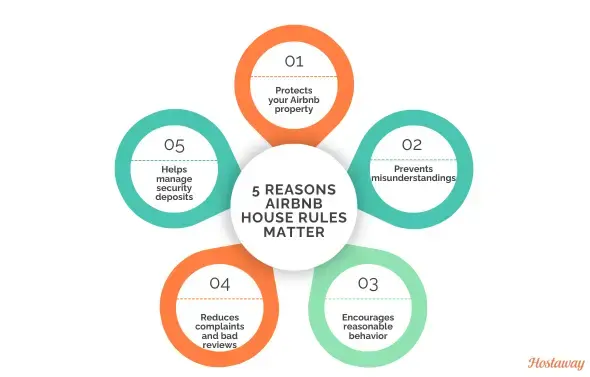
Having a house rules list isn’t just about maintaining order — it directly impacts your guest experience and Airbnb business. Here’s why they matter:
Protects your Airbnb property
Specific rules for guests prevent damage, excessive wear and tear and unnecessary extra cleaning fees.
Prevents misunderstandings
When guests understand expectations upfront, they’re less likely to cause issues or break specific rules.
Encourages reasonable behavior
Guests are more likely to respect the space when they are made aware of your own house rules.
Reduces complaints and bad reviews
Clear rules prevent conflicts with previous guests, neighbors crazy about excessive noise or other disturbances.
Helps manage security deposits
If an Airbnb guest disregards your custom rules, you can enforce financial penalties or seek reimbursement through Airbnb.
9 Tips for Writing Effective Airbnb House Rules
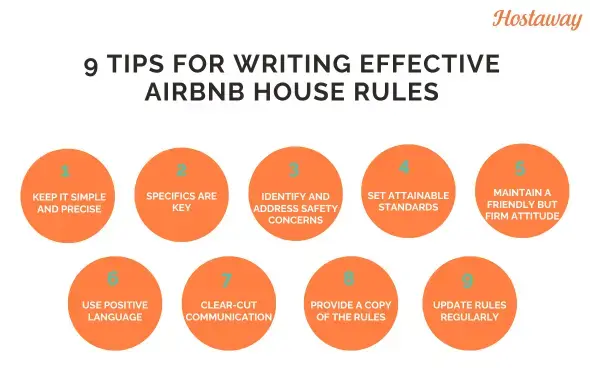
1. Keep it simple and precise
Don't confuse your guests with technical jargon or complex language in your house rules. Write your house rules in simple language that anyone can comprehend. Keep them short and straightforward.
Avoid using long sentences or paragraphs. Use bullet points or numbered lists to break down your rules into smaller, manageable sections. This will help guests remember and follow them.
Rather than stating "Food consumption is prohibited in the bedrooms," state "Please don't eat or drink in the bedrooms." - This is more precise and simple.
2. Specifics are key
Be specific about what behaviors are acceptable and what are not.
For instance, you might impose quiet hours or ask guests to clean up after themselves. You might also restrict access to certain areas, such as the pool or hot tub.
Your rules should cover all the important aspects of your property, which can also include check-in and check-out times, maximum occupancy, noise level, smoking policy and so on.
Your house rules are intended to facilitate your need for instructing guests on what they can and cannot do. They are unique and tailored to meet your expectations concerning how your property should be used during their stay.
Examples:
“No additional visitors or overnight guests are allowed without prior approval from the host.”
Or
“There are quiet hours from 10:00 pm to 8:00 am. We ask that guests keep their noise levels down during these hours.”
When defining your rules, being specific is conducive to avoiding confusion.
3. Identify and address safety concerns
As a host, you have the responsibility to ensure that your guests stay in a safe environment. You can implement safety-related rules, such as not smoking, not burning candles or not having parties.
On a side note make sure your vacation rental property is equipped with working smoke detectors and fire extinguishers. Every Airbnb property should have this safety precaution.
4. Set attainable standards
Make sure your rules are reasonable and achievable for guests. Avoid setting overly strict rules that may be difficult to follow or cause discomfort. Be clear about what guests can expect during their stay and what they can and cannot do on your property.
Keep your language clear and avoid vague terms that may be interpreted differently.
For example, instead of saying "keep the house clean," specify what that means: "wash your dishes and put them away after use," "wipe down the counters after preparing food" and "dispose of trash properly."
To communicate what rules must be followed, you can break them down into simple terms, even if it means a few extra short sentences.
5. Maintain a friendly but firm attitude
It's important to be firm with your rules, but also friendly and approachable. You want your guests to feel welcome and comfortable but also understand the importance of following your guidelines.
6. Use positive language
Try to phrase your rules positively, rather than using negative language that can come across as aggressive or unwelcoming.
Example:
The alternative to stating "No loud parties" would be to state "Please be respectful of our neighbors and keep noise levels down after 11 pm."
Instead of just outlining what guests can't do, suggest alternatives or solutions. For example, if you don't want guests to wear shoes inside, provide indoor slippers.
7. Clear-cut communication
It's important to explain to guests your expectations, including check-in and check-out times, lock keypad usage and how to report any issues. Providing emergency contact information is also important.
8. Provide a copy of the rules
To avoid confusion or misunderstandings, send your guests a copy of your house rules before they arrive, either via email or have a printed version inside the property.
You can include the house rules in the guest welcome book or digital guide.
9. Keep rules up to date
Regularly review and update your house rules to reflect any changes in your property or policies. Inform guests of any updates that may affect their stay.
Airbnb House Rules — Categories, Descriptions & Examples
Rule category | Why it matters | Example rule |
Noise / behavior | Prevents complaints, maintains good relations with neighbors | “Quiet hours from 10 PM to 7 AM” |
Smoking policy | Reduces fire risk and property damage | “No smoking indoors. Designated area outside only” |
Guests & visitors | Limits liability and wear-and-tear | “No unregistered guests allowed without prior approval” |
Parties / events | Helps avoid damage, noise complaints and community pushback | “No parties or events allowed” |
Pets | Prevents allergic reactions, damage, or excessive cleaning | “Pets allowed only with host approval; pet fee may apply” |
Cleanliness | Keeps property sanitary, reduces cleaning workload | “Wash dishes after use; dispose of trash in outdoor bins” |
Safety | Minimizes liability and ensures guest well-being | “Do not burn candles or tamper with smoke detectors” |
Energy use | Reduces utility waste and promotes sustainability | “Please turn off lights and AC when leaving the property” |
Amenities use | Ensures shared amenities are used safely and respectfully | “Pool open 8 AM–10 PM; no glass containers in pool area” |
Parking | Prevents conflicts with neighbors or towing issues | “Park only in designated driveway; do not block others” |
Garbage disposal | Keeps the space clean, avoids pest issues | “Place trash bins by the curb on Tuesdays; return them after collection” |
Respect for others | Promotes positive reviews and peaceful coexistence with neighbors | “Be considerate of neighbors; avoid loud noise or disruptive behavior” |
Common Airbnb House Rules Examples
.webp?u=https%3A%2F%2Fimages.ctfassets.net%2Fpqmtoyw9z10u%2F4AOB9ANDgNqLaMu1XGYSmM%2F1688f2f33a54592b2d0f214e2546412c%2FCommon_Airbnb_House_Rules_Examples__1_.webp&a=w%3D590%26h%3D337%26fm%3Dwebp%26q%3D75&cd=2025-02-17T13%3A43%3A16.022Z)
No smoking: Smoking is prohibited inside the property. Guests may smoke in the designated outdoor area and must dispose of cigarette butts properly.
No parties or events: Parties and events are not allowed. Quiet hours are from 10 PM to 7 AM.
No unregistered guests: Only registered guests are allowed on the property. Additional visitors are not permitted without prior approval.
Pet policy: Pets are not allowed unless approved in advance. A pet fee may apply.
Cleanliness: Please keep the property clean and tidy. Dispose of trash in the designated bins and wash dishes after use.
Energy conservation: Turn off lights and appliances when not in use and when leaving the property.
Parking: Park only in the designated parking space. Do not block neighboring driveways.
Garbage disposal: Trash collection is on [Day]. Please place the bins by the curb the night before and return them after collection.
Use of amenities: Pool hours are from 8 AM to 10 PM. No glass containers are allowed in the pool area.
Respect for neighbors: Please be considerate of our neighbors. Avoid loud noise and disruptive behavior.
Sample Airbnb House Rules Template
Dear (Guest Name),
Welcome to my (Name of your Listing)! I hope you enjoy your stay. Please take a moment to review these house rules:
Respect quiet hours (11 PM - 8 AM)
No smoking inside
No unregistered guests without prior approval
Keep the space tidy and clean up after yourself
Report any damages immediately
If you have any questions, feel free to reach out!
Cheers,
(Host Name)
Feel free to personalize this Airbnb house rules template to suit your entire property and update it as needed.
How to Add House Rules to Your Airbnb listing
Your house rules will appear on your listing page and guests will need to agree to them before booking your vacation rental.
Go to 'Listings' and select the listing you want
Under Policies and Rules, go to House rules
Edit or add additional rules.
Make your changes and click Save!
What Happens If a Guest Violates House Rules?
%20(1).webp?u=https%3A%2F%2Fimages.ctfassets.net%2Fpqmtoyw9z10u%2F6GHZ2HgpxmEixs7ms4ixWU%2F8473ae96b21552c1887393bc1f034e9d%2FWhat_Happens_If_a_Guest_Violates_House_Rules__2___1_.webp&a=w%3D590%26h%3D337%26fm%3Dwebp%26q%3D75&cd=2025-02-17T13%3A45%3A37.893Z)
If a guest breaks your house rules, you have several options to address the situation effectively.
1. Communicate directly with the guest
The first step is to send a polite but firm message via the Airbnb message thread reminding the guest of your rules. Often, a simple reminder can resolve the issue without further action.
2. Document the violation
If the issue persists, it’s important to gather evidence. Take photos or videos of any damage, excessive mess or rule-breaking activity. This documentation will be useful if you need to report the issue to Airbnb or request compensation.
3. Leave an honest review
After the guest checks out, leave a truthful and professional review detailing the issue. This helps future hosts make informed decisions about accepting the guest.
4. Report the issue to Airbnb
If the violation is serious or continues despite your warnings, report the suspected or actual violation to Airbnb. Follow these steps:
Submit documentation such as photos, videos or message threads
Request Airbnb support for necessary action, such as canceling the booking or imposing penalties on the guest
Taking swift action ensures your Airbnb property remains well-managed and prevents future issues with difficult guests.
The Airbnb Commitment to House Rules
As part of Airbnb's commitment to enforcing these ground rules, Airbnb provides information about the policy and issues warnings to guests.
In cases of repeated or severe violations of these ground rules, they may suspend or remove guests from the Airbnb community itself.
In addition to the standard house rules, Airbnb also allows hosts to include a written set of additional rules. Guests will be notified in advance of the house rules or additional rules.
If a guest disregards any of the additional rules, Airbnb will support the host if they need to cancel the reservation.
Are Airbnb House Rules Legally Binding?
.webp?u=https%3A%2F%2Fimages.ctfassets.net%2Fpqmtoyw9z10u%2F6NZHrGmC1TxgEMuZlcSYm5%2Fa6e60a636fac06a15244715551194c67%2FAre_Airbnb_House_Rules_Legally_Binding__1_.webp&a=w%3D590%26h%3D337%26fm%3Dwebp%26q%3D75&cd=2025-02-17T13%3A47%3A57.602Z)
Yes, Airbnb house rules are legally binding to a certain extent. When a guest books your property, they agree to Airbnb’s terms of service, which include compliance with host rules.
However, while these rules are enforceable within Airbnb’s platform, they may not always hold up as a legally binding document in a court of law.
Exceptions and considerations
Although Airbnb’s terms of service are backed by a legal team, your own house rules could be more challenging to enforce independently in legal proceedings.
If a guest dispute escalates beyond Airbnb’s resolution center and into a court case, your house rules alone may not be sufficient to prove a legal breach unless incorporated into a more formal rental agreement.
Making your house rules more enforceable
Some Airbnb hosts opt to include their house rules in a rental agreement that guests must sign upon booking. This gives the rules more legitimacy and, in some cases, can be considered a legally binding contract.
If a guest violates a rule outlined in a signed rental agreement, it may be treated as a breach of contract, potentially leading to legal consequences such as loss of a damage fee or legal action for damages.
Balance Airbnb House Rules With Hospitality
Setting clear house rules is key to keeping your Airbnb running smoothly. They help guests know what to expect, protect your property from damage and prevent potential issues.
While you have the authority to set rules as you see fit, it’s important to strike a balance — protecting your property while keeping your listing appealing.
Guests are looking for a relaxing getaway, not a long list of restrictions, so communicate your rules in a clear, concise and welcoming way.
Airbnb House Rules FAQ
1. What are Airbnb house rules and why are they important?
Airbnb house rules are guidelines set by hosts to inform guests about acceptable behaviors and expectations during their stay. They help protect your property, prevent misunderstandings, encourage respectful behavior and reduce the risk of complaints or damage.
2. What should I include in my Airbnb house rules?
Effective house rules should cover behavior guidelines (like quiet hours), amenity usage, cleaning expectations, safety measures, policies on guests and pets and consequences for rule violations. Be specific and clear to avoid confusion.
3. How do I communicate my house rules to guests?
You should send your house rules to guests before arrival, either via email or by providing a printed or digital copy inside the property. Airbnb also allows you to display your rules on your listing page, which guests must agree to before booking.
4. What happens if a guest violates my house rules?
If a guest breaks your house rules, start by communicating directly and politely reminding them of the rules. Document any violations, leave an honest review after checkout and if necessary, report the issue to Airbnb with supporting evidence for further action.
5. Are Airbnb house rules legally binding?
Airbnb house rules are enforceable within the Airbnb platform, as guests agree to them when booking. However, they may not always be legally binding in court unless incorporated into a formal rental agreement signed by the guest.
6. How can Hostaway help me manage and enforce house rules?
Hostaway’s property management platform allows you to automate guest communications, share house rules easily and track guest compliance. With features like automated messaging and digital guidebooks, you can ensure every guest receives and acknowledges your rules, helping you maintain control and compliance across all your listings.
Ready to find out how Hostaway can transform your business?